Modern data centers rely on highly specialized rooms to ensure stable power delivery, secure network connectivity, and efficient internal traffic management. Among these critical areas, the EMOD Room, MMR, and SER each play unique roles in maintaining the reliability of the entire facility.
Understanding the differences between these rooms is essential for data center designers, contractors, and infrastructure managers—especially when planning structured cabling and fiber distribution systems.
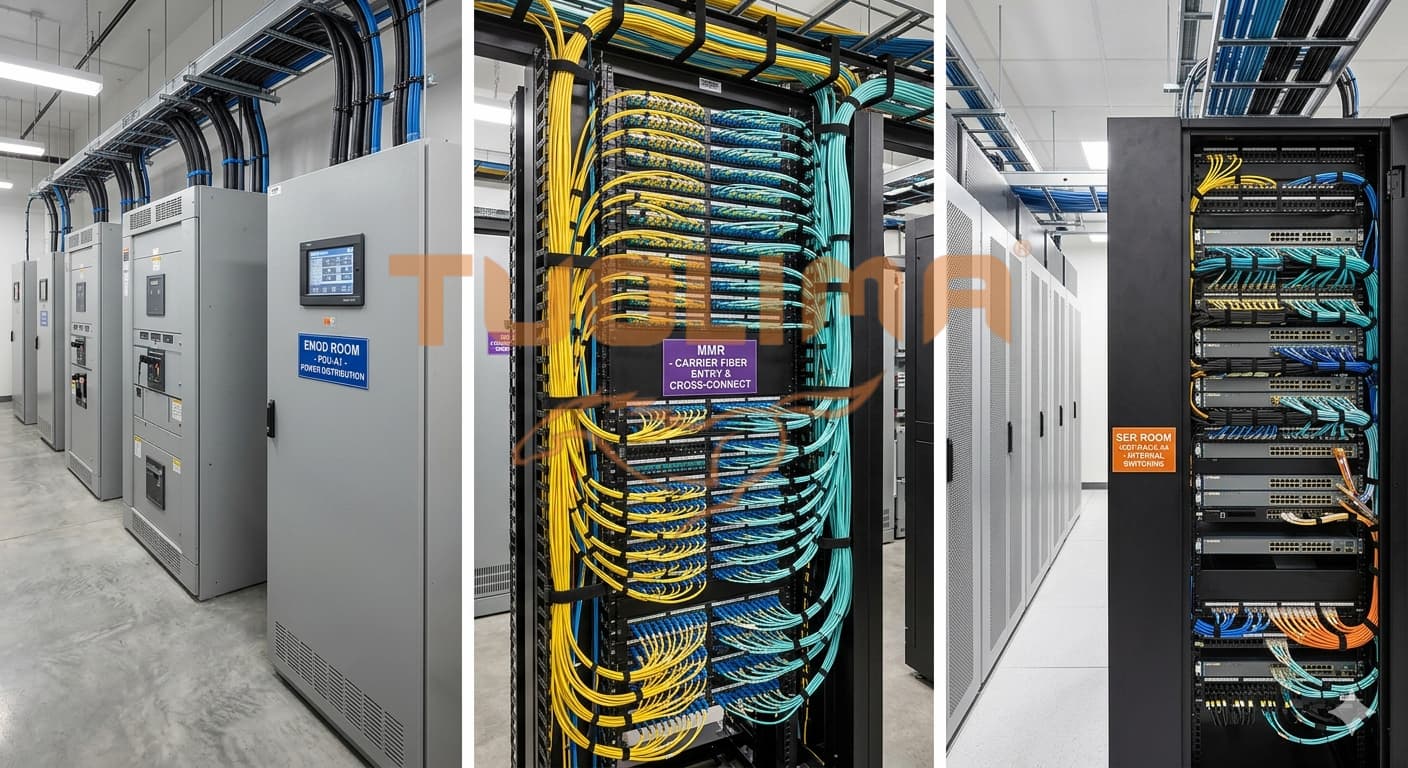
An EMOD Room (Equipment, Mechanical, Operations & Distribution) is a dedicated area that houses the electrical distribution infrastructure of a data center.
It is responsible for distributing power from upstream systems to the data halls while maintaining redundancy and resilience.
Typical equipment in an EMOD room includes:
Power Distribution Units (PDUs)
Remote Power Panels (RPPs)
Switchgear
UPS output distribution systems
Fire detection interfaces
A/B redundancy control systems
In hyperscale and enterprise data centers, EMOD rooms are often designed as modular prefabricated units, allowing faster deployment and easier scalability.
These rooms are the backbone of data center power distribution, ensuring that servers and network systems receive uninterrupted electrical supply.
The Meet-Me Room (MMR) is the central point where external network carriers connect to the data center.
This room serves as the interface between telecom providers and the facility’s internal network infrastructure. It is where:
Carrier fiber enters the building
Cross-connections are made
Interconnection services are managed
Network handoffs are completed
Because multiple service providers converge in the MMR, high-density fiber management systems are critical to maintain organized routing and easy maintenance.
Reliable products commonly used in MMR environments include:
Fiber Distribution Frames (ODF)
Rack-mounted patch panels
Fiber splice trays
Cable management accessories
Efficient fiber organization in the MMR helps reduce downtime and improves scalability for future network expansion.
The Server Equipment Room (SER) supports the internal network operations of the data center.
Unlike the MMR, which handles external connectivity, the SER manages internal switching and routing functions. This room typically contains:
Core switches
Spine-leaf switches
Routing devices
Patch panels
Structured cabling systems
The SER is essential for maintaining smooth data traffic between servers, storage systems, and external networks.
Well-designed structured cabling in the SER improves airflow management, simplifies maintenance, and enhances network reliability.
Although these rooms work together, their purposes are very different:
Handles electrical distribution, ensuring stable and redundant power delivery.
Handles external connectivity, linking carrier networks to the facility.
Handles internal network distribution, managing traffic inside the data center.
In simple terms:
EMOD = Power
MMR = External Fiber Connectivity
SER = Internal Network Switching
Each room requires carefully planned infrastructure to maintain uptime and performance.
Whether in the EMOD, MMR, or SER, organized infrastructure directly affects operational reliability.
Proper cabling systems provide:
Easier maintenance
Better airflow management
Reduced signal loss
Faster troubleshooting
Greater scalability
In MMR and SER environments especially, fiber distribution boxes, ODF systems, and patch panels play a vital role in maintaining organized and efficient fiber routing.
Without proper cable management, even advanced data center systems can face unnecessary downtime and maintenance complexity.
At Tuolima, we provide professional fiber management solutions designed for critical data center environments, including:
Fiber Optic Distribution Frames
Rack Mount Fiber Patch Panels
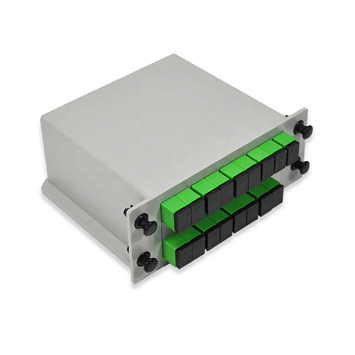
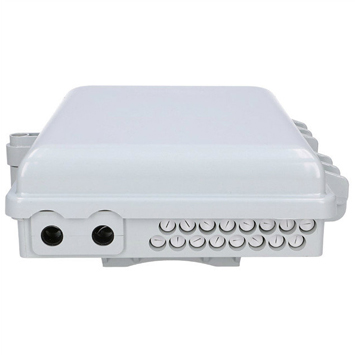
Fiber Distribution Boxes
Cable Management Accessories
These products help operators build reliable and scalable infrastructure across MMR rooms, SER rooms, and structured cabling systems, improving overall network stability and operational efficiency.
As data centers continue to expand to meet growing cloud and AI demands, dependable infrastructure components remain essential to supporting long-term performance.
EMOD stands for Equipment, Mechanical, Operations & Distribution. It is the room that manages electrical power distribution within a data center, including PDUs, switchgear, and UPS systems.
An MMR (Meet-Me Room) is where telecom carriers connect their fiber networks to the data center. It acts as the main interconnection point for external network services.
An SER (Server Equipment Room) usually contains core switches, routers, patch panels, and structured cabling systems that manage internal data traffic.
Proper fiber management in MMR rooms ensures organized routing, reduces maintenance time, improves scalability, and minimizes downtime risks.
Common products include ODF systems, fiber patch panels, splice trays, fiber distribution boxes, and cable management accessories, all of which help maintain reliable connectivity.
Related Products
IP68 Fiber Optic Splice Closures — Designed to provide secure and reliable protection for fiber optic joints
Aug 02-2024

Enhancing Campus Connectivity: GJYXCH Fiber Optic Cable in Educational Networks
Jan 09-2024
Elevating Urban Infrastructure: GJYXCH Fiber Optic Cable in Smart City Networks
Jan 07-2024
 English
  français
  Deutsch
  Español
  italiano
  русский
  português
  العربية
  ไทย
ไทย  Polska
  română