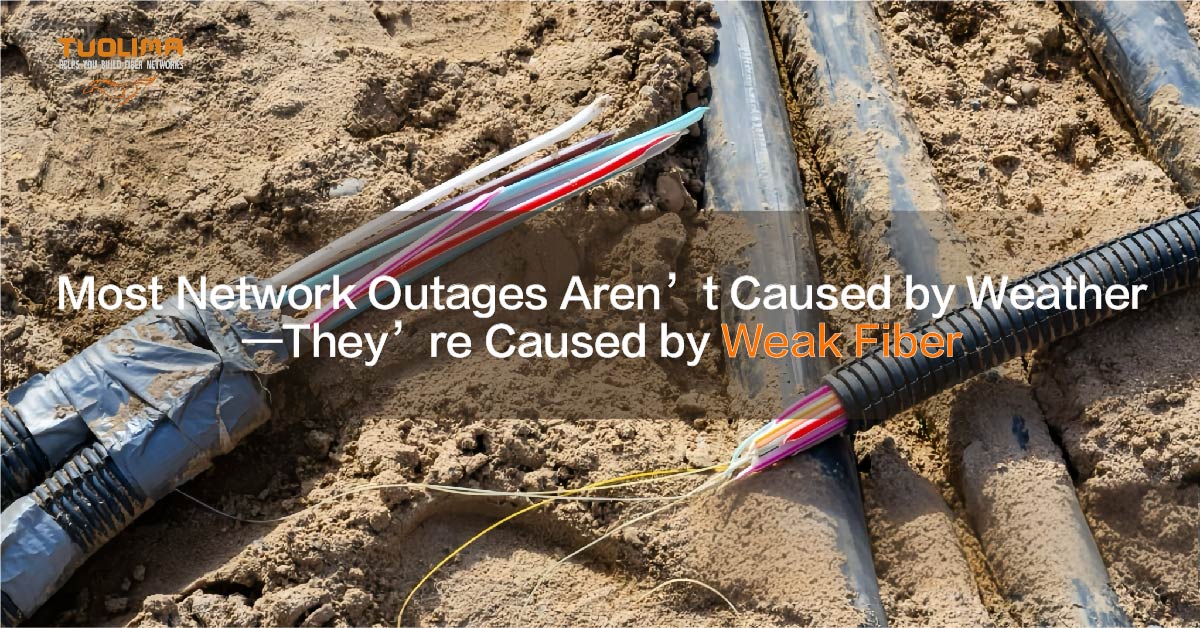
Climate disasters are escalating. Conflicts are damaging infrastructure. Repair budgets are rising across continents. Yet when networks collapse, the culprit is rarely the storm itself. It’s the cable that was never designed to survive one.
Across thousands of kilometers of outdoor deployments, operators are discovering an uncomfortable truth:
extreme weather exposes weak fiber, but it doesn’t create weakness.
Material fatigue, poor UV resistance, low-tension strength, and fragile enclosures do far more harm than rain, wind or ice ever could.
As 2026 arrives, outdoor fiber design enters a new phase. What survived ten years ago will no longer survive ten months.
A Harsh Reality: “Cheap Fiber Is Becoming the Most Expensive Decision”
In 2025 alone, network operators across Asia, South America, and Eastern Europe reported:
l rising maintenance frequency on aerial fiber lines
l unexpected mid-span breaks after storms
l water-damaged FTTH boxes in high-humidity regions
l early UV cracking on low-quality sheath materials
l connector corrosion inside poorly sealed outdoor terminals
These failures weren’t driven by record-breaking weather. They were driven by fiber and FTTH components that were never built for long-distance tension, tropical UV intensity, or high wind load.
And as more regions move to aerial deployment—from Brazil’s rural highways to Southeast Asia’s cross-river spans—the pressure on outdoor fiber will only intensify.
Weak fiber is no longer a cost-saving choice. It is a guaranteed loss in the next storm cycle.
The Hidden Physics Behind Outdoor Fiber Failure
Outdoor fiber is not defeated by a single force.It is defeated by the accumulation of micro-damage.
1) UV Degradation: The Silent Cracks
Aerial cables in equatorial regions endure UV intensity five times higher than in northern climates.
Low-grade polyethylene hardens, cracks microscopically, then splits under tension.
This is why UV resistant fiber cable is now a high-search keyword in global FTTH markets.
2) Excessive Span = Inevitable Sag
When ADSS is stretched beyond its rated span, tension drops, sag increases, and mid-span stress concentrates.
Once sag meets strong wind, cables begin oscillating, accelerating fatigue.
3) Moisture Ingress: The Death of FTTH Termination
An unsealed outdoor FTTH box is a time bomb.
Moisture corrodes fibers from inside—no storm required.
High-humidity regions in South America and Southeast Asia report that FTTH outdoor enclosure waterproofing now matters more than product cost.
4) Incorrect Installation Multiplies Every Weakness
wrong tension
mismatched anchor clamps
bending radius violations
placing boxes in direct UV exposure
unsealed ports inviting moisture
Even good fiber can be installed to fail.
Why 2025 Networks Demand Stronger Fiber Than Ever
Outdoor infrastructure is entering a decade shaped by:
1. Stronger weather cycles
Wind loads are rising.
Ice loads are increasing in cold zones.
Tropical climates are seeing longer rainy seasons.
2. More aerial fiber construction
Rural broadband expansions often skip underground ducts.
Aerial deployment has become the backbone of connectivity from Brazil to India.
3. Higher customer bandwidth expectations
Streaming, remote work, and 10G PON acceleration leave no room for unstable connections.
4. Scarcity of skilled maintenance labor
The cost of repairing weak fiber is now higher than the cost of buying high-quality materials from the start.
In this environment, the priority is clear:
networks must be engineered for the next ten years, not for next quarter’s budget report.
The New Standard for Outdoor Fiber Durability
To build infrastructure that survives 2025 and beyond, operators are shifting toward:
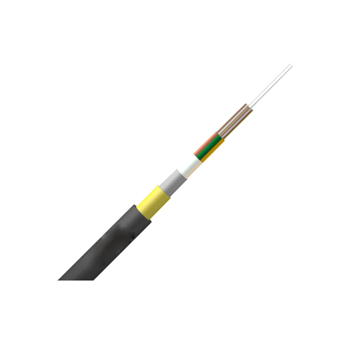
1. High-Tensile ADSS Cable
Keyword relevance: ADSS cable, aerial fiber installation, high tensile ADSS
A new generation of ADSS requires:
l high-tension capability for crossed rivers and long rural spans
l all-dielectric structure for storm-prone zones
l aramid reinforcement to resist oscillation
l UV resistant outer sheath for equatorial climates
Weak ADSS breaks quietly—strong ADSS survives quietly.
2. Climate-Resistant Outdoor Fiber Cable
Keyword relevance: extreme weather fiber, UV resistant fiber cable, climate-resistant fiber cable
Regions with intense UV, heavy salt air, or desert climates now require:
l UV-stabilized PE jackets
l anti-corrosion components
l moisture-blocked tube systems
l aramid yarn for tensile balance
Not all “outdoor fiber” is made equal.
Climate defines durability.
3. Waterproof Outdoor FTTH Enclosures
Keyword relevance: FTTH outdoor enclosure, waterproof FTTH box
The smallest FTTH boxes often determine the stability of the entire line.
What matters now:
l IP65 or higher sealing
l UV-stable polycarbonate
l anti-condensation internal design
l secure cable entry glands
l anti-aging hinges
A box that allows a drop of water to enter can take down 64 households.
A good enclosure prevents that story.
4. Field-Proven Small Termination Boxes
These compact boxes—especially patented, reinforced models—solve the real issues installers complain about:
l failing latches
l fading color due to UV
l cracking under long-term sun exposure
l poor hinge durability
l insufficient space for drop cable looping
This is where finish quality matters most.
Installers know instantly whether a box is built to last or “built to be replaced.”
2026 Outdoor Fiber Checklist for ISPs & Operators
A future-proof deployment must answer:
1. Can it survive 10 years of UV?
If not, it won’t survive two years in Brazil or Thailand.
2. Can it handle worst-case tension?
If not, ADSS mid-span breaks are inevitable.
3. Can the FTTH terminal stay sealed under humidity?
If not, corrosion will start immediately.
4. Are all components matched—anchors, clamps, brackets?
If not, installation stress multiplies.
5. Is the fiber built for the terrain, not the catalog?
Terrain always wins against theory.
6. The Bigger Truth: Strong Networks Are a Choice
Storms are not preventable.
Conflicts are unpredictable.
But fiber quality, enclosure design, and long-span engineering are choices.
The networks that will survive the coming decade are being built now by operators who understand that:
long-term resilience is cheaper than short-term savings.
And the operators who continue buying weak fiber will experience outages that were avoidable from day one.
Conclusion: Weather Exposes Weakness; It Doesn’t Create It
Outdoor fiber infrastructure is stepping into its most demanding decade.
Wind will rise.
Rain will intensify.
Humidity will increase.
And the world will lean even more heavily on digital connectivity.
Weak fiber will break under this pressure.
Strong fiber will outlive it.
The difference is not in the climate.
The difference is in the choices made today.
Related Products
IP68 Fiber Optic Splice Closures — Designed to provide secure and reliable protection for fiber optic joints
Aug 02-2024

Enhancing Campus Connectivity: GJYXCH Fiber Optic Cable in Educational Networks
Jan 09-2024
Elevating Urban Infrastructure: GJYXCH Fiber Optic Cable in Smart City Networks
Jan 07-2024
 English
  français
  Deutsch
  Español
  italiano
  русский
  português
  العربية
  ไทย
ไทย  Polska
  română