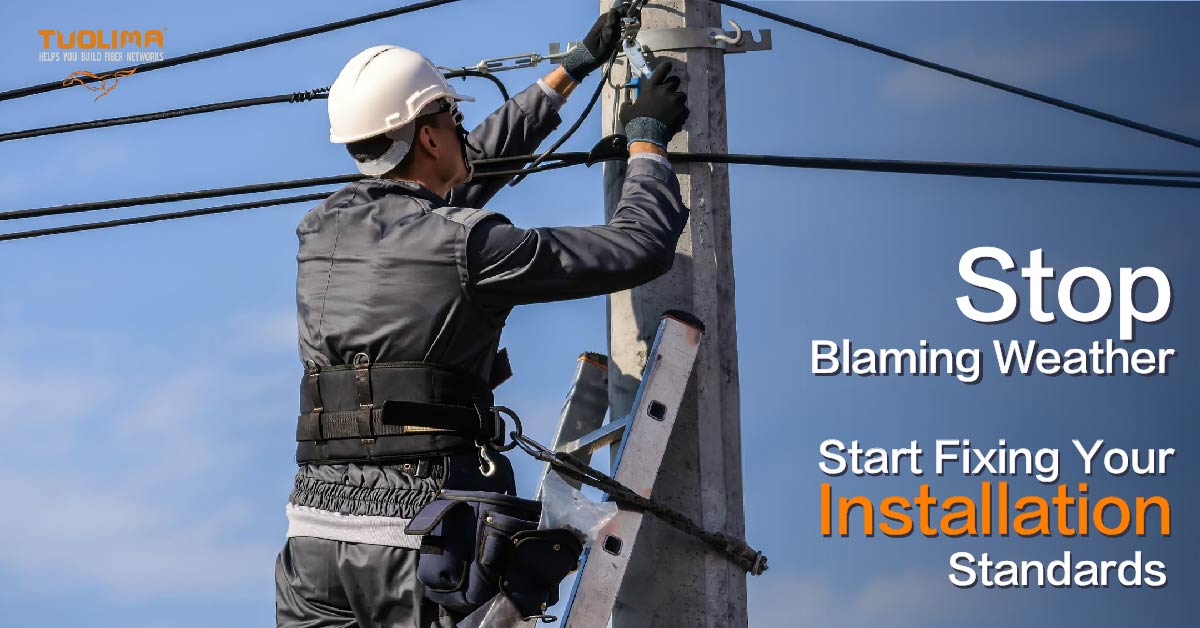
Outdoor fiber networks are failing faster than expected — not because the fiber is weak, but because installation mistakes silently destroy cable long before weather does. Across aerial deployments, ADSS spans, and FTTH last-mile rollouts, operators are learning that even high-quality materials cannot survive poor engineering decisions.
Today’s outages are no longer driven solely by storms or climate. They are driven by human-made errors, rushed builds, and mismatched components. And for ISPs expanding fast in rural or high-humidity regions, these mistakes can become catastrophic.
This article examines the 7 installation mistakes that cause the majority of fiber optic failures, and how operators can avoid them with better ADSS installation practices, proper FTTH enclosure waterproofing, and correct aerial tension management.
Why 70% of Outdoor Failures Are Human-Made
Most operators assume extreme weather is the main threat. But field data shows something different:
over 70% of outdoor fiber failures originate from installation, not environment.
Common human-made triggers include:
l Misaligned tension on ADSS cables, causing micro-cracks
l Incorrect bending radius, especially in pole transitions
l Poor pole conditions, rusted hooks, or unstable attachments
These errors create weaknesses that rain, wind, UV, or ice only finish off later.
This means:
Even the best fiber optic cable can be installed to fail.
The 7 Most Common Installation Mistakes
1. Oversized spans causing long-term sag
Excessive span length is one of the most common aerial fiber problems. Long spans accumulate wind load and create downward tension that gradually deforms the jacket. Over time, sagging increases until the ADSS cable fails mid-span. Many rural builds make this mistake because installers “stretch the distance” to save hardware — at the cost of future failures.
2. Incorrect tension → fiber fatigue
Improper tensioning creates internal strain that weakens the glass fibers. Too tight and the cable snaps under thermal expansion; too loose and vibration damage occurs. This mistake is especially common in ADSS installation for long crossings or river spans.
3. Mismatched suspension or anchor clamps
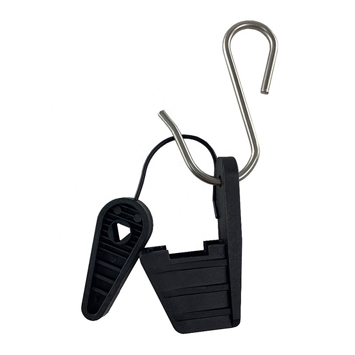
Using hardware that was never designed for the cable type multiplies stress points. A wrong clamp may cut into the jacket, deform the sheath, or slip under load — all leading to early failure. This issue appears frequently when operators buy clamps and cables from different suppliers.
4. Bending radius violations
The bending radius printed on the cable is not a suggestion; it is a survival limit. Tight corners at poles and boxes create micro-bending loss and long-term structural damage. It appears harmless during installation—but becomes a disaster three years later.
5. Unsealed FTTH terminals → water ingress
Water ingress remains the #1 cause of FTTH enclosure waterproofing failures. When the box is not fully sealed, humidity accumulates and corrodes connectors. In tropical regions, moisture damage can start in less than 48 hours. The problem is not the weather — it is poor sealing or using cheap boxes.
6. Using indoor boxes outdoors (“the silent killer”)
Some low-cost deployments use indoor termination boxes outdoors. Under UV and rain, these boxes crack, warp, or lose waterproofing. It is one of the most frequent hidden mistakes in fast FTTH last-mile installations.
7. Reusing old utility poles
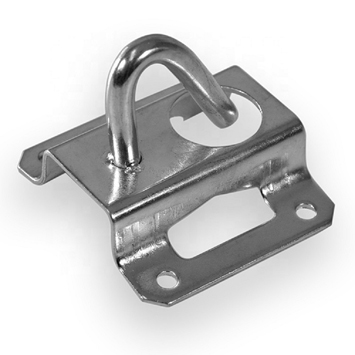
Old poles with rusted hooks or unstable structures create anchor point failures. Even perfect cable cannot compensate for collapsing pole infrastructure. Operators underestimate this risk because poles “seem fine” during installation — until they are not.
How Good Products Still Get “Installed to Fail”
Even a premium fiber optic cable or ADSS line can be destroyed by incorrect installation choices. Two silent killers cause most premature failures:
l Micro-cracks created during excessive pulling or bending
l Accelerated UV exposure caused by incorrect placement
Once these weaknesses exist, sunlight, rain, and wind simply expose the flaw. The environment isn’t the enemy — the installation error is.
Recommended Professional Solutions
To avoid these failures, operators should follow high-reliability engineering standards using:
l ADSS cable matched with correct fittings to prevent jacket deformation
l UV-resistant outdoor FTTH hubs and terminals
l Weather-sealed drop enclosures designed for high humidity regions
l Correct span planning based on terrain instead of catalog assumptions
l Full compatibility between anchors, clamps, and brackets
A resilient network is not built from strong materials alone — it is built from correct engineering choices.
Conclusion
A strong network begins where installers stop:
at the quality of every tension point, every bend, and every sealed enclosure.
Most fiber failures are preventable. And in an industry racing to expand FTTH, 5G backhaul, and rural fiber infrastructure, the operators who avoid these seven mistakes will build networks that last a decade — not a season.
Related Products
IP68 Fiber Optic Splice Closures — Designed to provide secure and reliable protection for fiber optic joints
Aug 02-2024

Enhancing Campus Connectivity: GJYXCH Fiber Optic Cable in Educational Networks
Jan 09-2024
Elevating Urban Infrastructure: GJYXCH Fiber Optic Cable in Smart City Networks
Jan 07-2024
 English
  français
  Deutsch
  Español
  italiano
  русский
  português
  العربية
  ไทย
ไทย  Polska
  română