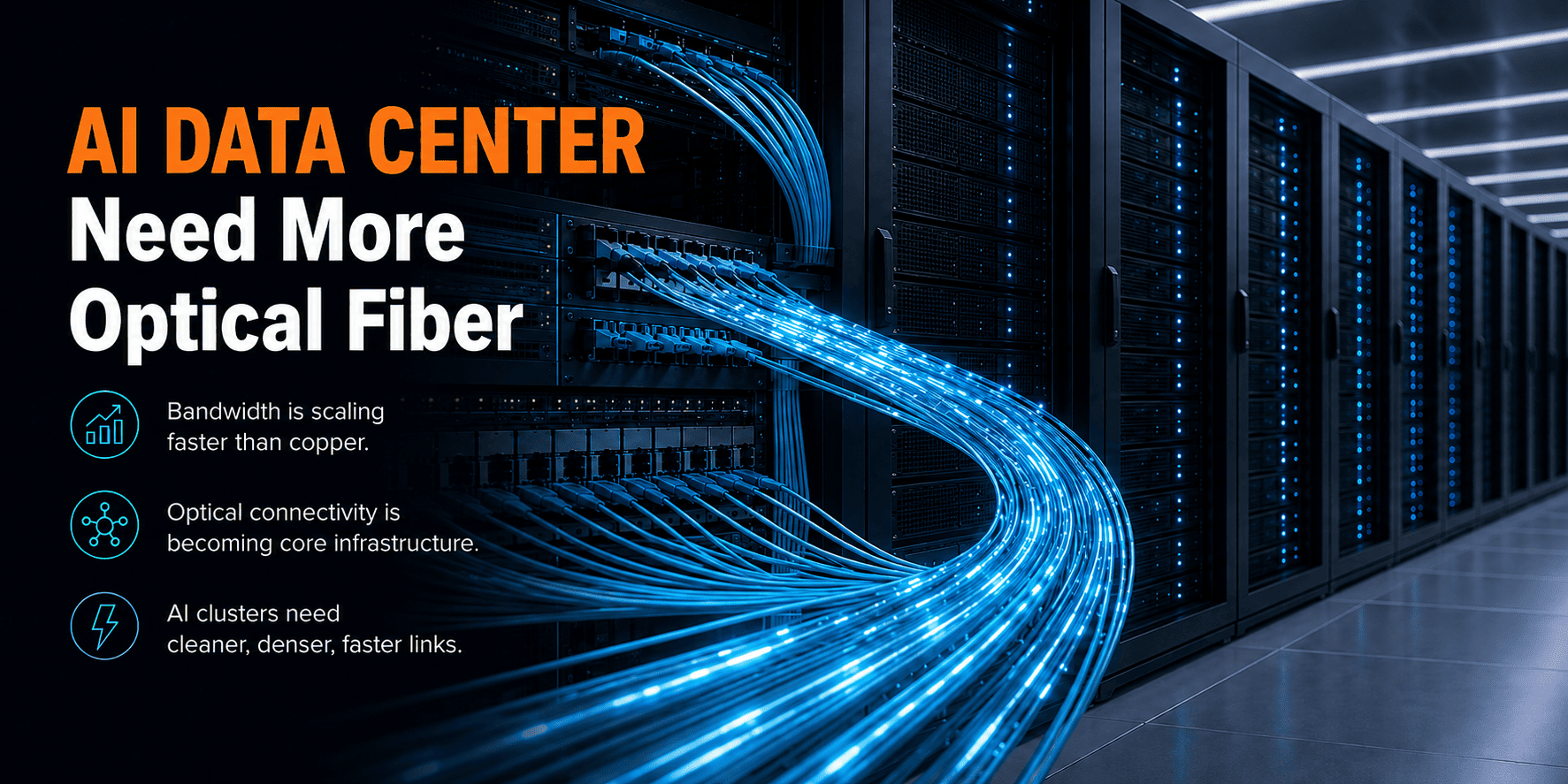
In May 2026, Data Center Knowledge reported that Nvidia was moving deeper into the physical infrastructure behind AI by partnering with Corning to expand optical connectivity manufacturing for large-scale GPU clusters. The report described the partnership as a move beyond chips and networking into the industrial supply chain needed to support next-generation AI campuses.
This is an important signal for the fiber optic industry.
AI infrastructure is no longer only about GPUs, servers and cooling systems. As AI data centers become larger and more power-dense, optical fiber, cable and connectivity systems are becoming part of the core infrastructure that determines whether AI clusters can scale efficiently.
According to Data Center Knowledge, the Nvidia-Corning partnership is expected to create new manufacturing facilities, support thousands of jobs and increase U.S. fiber manufacturing capacity by more than 50%. Nvidia CEO Jensen Huang said the partnership is intended to strengthen the U.S. supply chain for the AI era.
Corning also stated that its expanded capacity will supply the optical connectivity used by hyperscale data centers to deploy Nvidia-accelerated computing at scale. The company noted that modern AI workloads require thousands of GPUs and unprecedented volumes of high-performance optical fiber, connectivity and photonics to move data at high speed and scale.
For engineering teams and procurement teams, the message is clear: optical fiber is no longer a passive cabling component. It is becoming a strategic resource for AI infrastructure deployment.
Large AI data centers are built around dense GPU clusters. These clusters need to move huge volumes of data between thousands of accelerators with low latency and high bandwidth.
That means computing power alone is not enough.
If the network layer cannot move data efficiently, the performance of the entire AI cluster is affected. Data Center Knowledge quoted Sameh Boujelbene of Dell’Oro Group as saying that optical connectivity is becoming foundational to scaling AI infrastructure because moving data efficiently between thousands of GPUs is now as important as the compute itself.
This is the key technical point industry readers care about:
AI data centers do not only need more chips. They need stronger optical infrastructure to connect those chips.
Copper still has value in short-distance connections. But as AI clusters become larger, copper faces practical limits in several areas:
bandwidth capacity
transmission distance
thermal load
power consumption
cable density
long-term scalability
In high-density AI environments, these issues become more serious. More cables mean more heat, more physical congestion and more energy pressure.
This is why optical fiber is becoming more important. Fiber supports higher bandwidth over longer distances with lower signal loss and better scalability. It also helps reduce the physical and energy pressure created by large-scale interconnects.
Data Center Knowledge also noted that silicon photonics and co-packaged optics are becoming increasingly important because they can help reduce power and latency pressure as AI clusters scale.
For data center operators, this is not only a technology upgrade. It is a deployment requirement.
For many years, optical fiber was often treated as a standard procurement item. Buyers compared specifications, requested prices and selected suppliers based on project requirements.
The AI boom is changing that logic.
When hyperscale data centers require more fiber, cable and optical connectivity, the supply chain becomes more competitive. Reuters reported that Corning and Nvidia announced a partnership to expand U.S. production of optical connectivity products used in AI data centers, reflecting rising demand for the supporting infrastructure behind AI chips.
This matters for buyers outside the AI data center sector as well.
Telecom operators, ISPs, FTTH contractors and fiber network builders may face stronger competition for stable optical supply. Lead times, production allocation and product consistency may become more important in future procurement decisions.
In this environment, choosing optical fiber only by the lowest unit price becomes risky. Project teams need to consider:
supplier production stability
cable quality consistency
testing capability
delivery reliability
long-term field performance
suitability for the installation environment
Although the Nvidia-Corning news focuses on AI data centers, its impact reaches the wider optical communication industry.
AI infrastructure increases pressure on fiber manufacturing, optical connectivity and high-performance cabling. At the same time, telecom networks, broadband projects and FTTH deployments still need reliable optical infrastructure.
For outdoor telecom projects, the challenges are different from data center cabling, but the principle is similar: the network must be planned for long-term stability.
Aerial fiber routes, duct installations, direct burial cables, FTTH distribution networks and outdoor ODN systems all depend on reliable cable structure, mechanical strength, sealing performance and installation quality.
If fiber demand continues to grow, project owners cannot afford unstable materials, poor protection or frequent maintenance. The cost of failure is not only the cable price. It includes labor, repair time, delayed activation, service interruption and customer complaints.
At Tuolima, we believe the AI data center trend confirms a broader shift in the optical communication industry: fiber infrastructure is becoming more strategic, more demanding and more closely connected to long-term network performance.
For telecom operators, ISPs, contractors and infrastructure builders, fiber planning should begin earlier in the project cycle.
The right cable should match the real installation environment. Outdoor fiber optic cables need to support stable performance in aerial, duct or direct burial applications. FTTH and ODN components need to protect optical links from humidity, dust, UV exposure and repeated field maintenance. Splice closures and distribution boxes must maintain sealing performance and cable management reliability over time.
Tuolima provides fiber optic cables, FTTH connectivity products, splice closures, distribution boxes and related optical network infrastructure solutions for practical deployment scenarios.
The AI era may be led by hyperscale data centers, but its influence is reaching the entire fiber optic supply chain.
For project teams, the question is no longer only:
How much fiber do we need?
The better question is:
Is our fiber infrastructure ready for the next decade of network demand?
AI data centers need optical fiber because large GPU clusters must move huge volumes of data at high speed and low latency. As AI clusters scale, copper connections face limits in bandwidth, distance, heat and power consumption. Optical fiber provides better scalability for high-density AI infrastructure.
Optical fiber is not replacing copper in every connection. Copper can still be used for short-distance links. However, in large AI clusters, optical fiber is becoming more important because it supports higher bandwidth, longer distances, lower signal loss and better energy efficiency.
AI infrastructure increases demand for optical fiber, cable and connectivity products. This may create more pressure on the global fiber supply chain. Telecom operators, ISPs and FTTH contractors may need to plan procurement earlier and pay more attention to supplier stability, delivery time and product quality.
Buyers should consider the installation environment, cable structure, tensile strength, sheath material, water-blocking design, temperature resistance, testing standards and supplier delivery capability. For long-term infrastructure projects, reliability is more important than the lowest unit price.
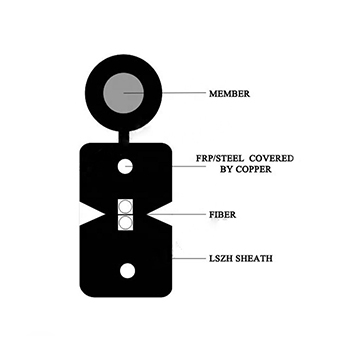
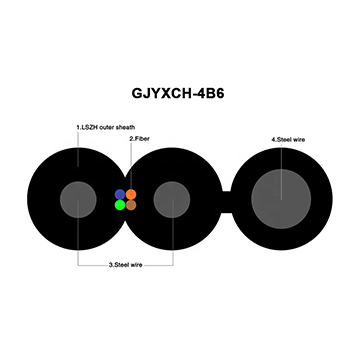
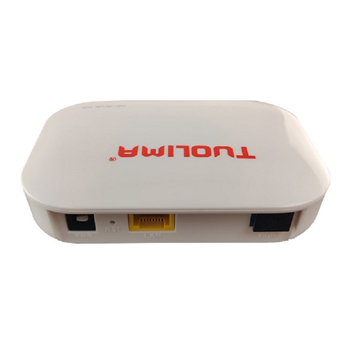
Tuolima’s related products include outdoor fiber optic cable, FTTH drop cable, fiber distribution boxes, fiber optic splice closures, ODN connectivity products and other fiber infrastructure components used in telecom and broadband network construction.
Related Products
IP68 Fiber Optic Splice Closures — Designed to provide secure and reliable protection for fiber optic joints
Aug 02-2024

Enhancing Campus Connectivity: GJYXCH Fiber Optic Cable in Educational Networks
Jan 09-2024
Elevating Urban Infrastructure: GJYXCH Fiber Optic Cable in Smart City Networks
Jan 07-2024
 English
  français
  Deutsch
  Español
  italiano
  русский
  português
  العربية
  ไทย
ไทย  Polska
  română